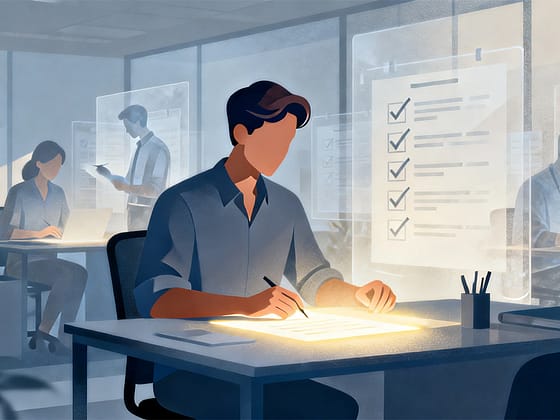
In many organizations, AI does not arrive as a dramatic layoff or a vanished role. It shows up quietly. A report drafts itself. A ticket is pre-categorized. A recommendation appears where a checklist used to be.
At first, this feels like efficiency. Nothing breaks. No one complains.
Public discussions about AI and work often jump from these small changes to a single question: which jobs will AI replace? It is an understandable reaction. It is also the wrong place to look.
AI systems rarely eliminate entire jobs. What they change instead is how work is divided, reassigned, and held together. Tasks move between humans and systems, and the seams between them become more visible.
The more useful question is not whether jobs disappear, but how tasks fragment — and what that fragmentation does to everyday work.
Jobs Are Bundles of Tasks, Not Atomic Units
Most roles are made up of many tasks with different levels of structure, judgment, and repetition. Some are predictable and well defined. Others depend on context, coordination, or accountability.
If this feels familiar, it is because most people encounter AI not as a replacement, but as a quiet rearrangement of what their day actually consists of.
AI systems tend to target specific tasks within a role rather than the role as a whole.
The role remains, but its internal shape changes. What once felt like a single workflow becomes a mix of automated output, human oversight, and leftover manual work that no longer fits neatly anywhere.
Automation Creates New Edges Instead of Clean Cuts
When a task is automated, it rarely disappears cleanly. Instead, new edges form around it.
- Inputs need to be prepared and checked
- Outputs have to be reviewed, interpreted, or corrected
- Exceptions surface when the system fails or behaves unexpectedly
These edge tasks collect around the automated core. Over time, people spend less effort performing the original task and more effort managing everything around it.
Consider a customer support team that adopts AI-assisted ticket classification. Agents sort fewer tickets by hand, but new work appears almost immediately. Misclassified tickets must be rerouted. Low-confidence outputs need review. Customers ask why their issue ended up in the wrong queue.
The original task shrinks, but oversight, correction, and explanation expand. Eventually, this becomes the job.
Productivity Gains Mask Coordination Costs
At the level of individual tasks, AI-driven automation often does deliver real efficiency. But as tasks fragment, coordination costs rise.
As tasks fragment, work becomes harder to sequence. Dependencies multiply. Handoffs increase between people and systems, and between teams adopting AI at different speeds.
These costs are diffuse and easy to miss in productivity metrics. They tend to surface instead as slower approvals, longer handoffs, and growing hesitation around automated outputs.
Skill Requirements Shift Sideways, Not Upward
AI adoption is often described as upskilling. In practice, it usually produces sideways shifts in what people are expected to know and do.
Workers find themselves asked to:
- Supervise systems they did not design
- Interpret outputs that are probabilistic rather than definitive
- Decide when to trust or override recommendations
- Take responsibility for outcomes they only partially control
These skills differ from the original task expertise and tend to surface after deployment, when workers are suddenly expected to manage systems they did not choose or shape. They are not necessarily more advanced, but harder to define and harder to train for.
Responsibility Fragments Alongside Work
As work fragments, accountability fragments with it.
When outcomes depend on a mix of human judgment and model output, responsibility becomes shared or unclear. When something goes wrong, it is often difficult to say whether the failure was technical, procedural, or human.
This ambiguity becomes visible when an AI recommendation contributes to a bad outcome. A system generates an option. A manager approves it. Another team executes it. When problems appear later, responsibility is distributed, but not well defined.
In response, people slow decisions, add extra review steps, or push choices upward to protect themselves from blame. The result is not replacement, but friction.
Why Displacement Feels Uneven
Because task fragmentation affects roles differently, the impact of AI often feels uneven.
Two people with the same job title may experience AI in very different ways depending on which parts of their work are automatable. Some see relief from routine tasks. Others inherit more oversight, exception handling, or coordination work.
This helps explain why aggregate employment data often misses lived experience. The change happens inside jobs, not just across them.
Organizations Are Not Designed for Fragmented Work
Most organizational structures assume stable roles and clear responsibilities. Task fragmentation quietly undermines those assumptions.
Performance metrics lag behind reality. Job descriptions age quickly. Career paths blur as tasks shift faster than roles can be redefined.
Without deliberate redesign, fragmentation accumulates, increasing stress and reducing clarity without triggering formal change.
What AI Is Really Changing About Work
AI’s impact on jobs is not best understood as mass replacement. It is better understood as redistribution.
Tasks move between humans and machines. Responsibilities shift without being formally renegotiated. Work becomes more modular, but also more interdependent.
Understanding this dynamic explains why AI can feel transformative without producing clear productivity gains or visible job losses.
The Question That Actually Matters
The critical question is not which jobs AI will replace.
It is how organizations will adapt to work that is increasingly fragmented, recomposed, and coordinated across humans and systems.
The answer determines whether AI improves working lives or simply rearranges complexity inside roles that already feel stretched.